The figure in the light
The Cabin at the End of the WorldThe figure in the light is a presence Eric reports sensing in the cabin around the time Redmond was killed, and its uncertain status becomes part of the story’s final crisis. Eric describes an experience that seems to him more substantial than a passing flash: a presence that entered the circle around Redmond, regarded him, and remained near the cabin afterward. Andrew attributes the experience to Eric’s concussion, while Sabrina’s narration denies that any light was ever there. The figure is never independently confirmed, and its absence at the end leaves Eric facing a choice without the intervention he hopes it might provide.
First Perception in the Cabin
Eric first explains his experience after the deaths of Redmond, Adriane, and Wen. He tells Sabrina that, just before Redmond was killed, he sensed something in the room. To convey the sensation, he compares it to dropping an egg into water and feeling the water rise around it: the space seemed displaced by a presence. The comparison makes the experience bodily and spatial, even though Eric cannot identify what entered the room.
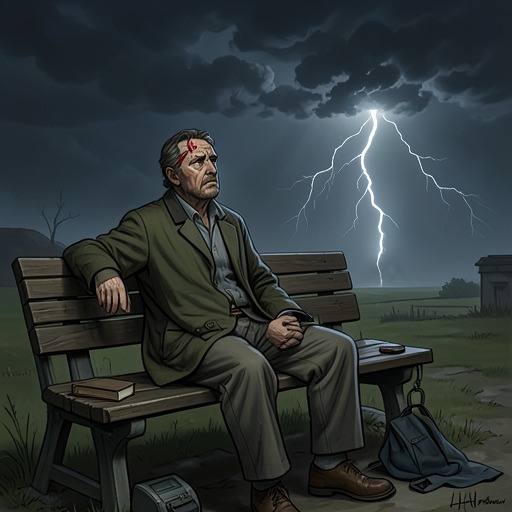
He says that something appeared and joined the circle around Redmond before the group began to kill him. Eric initially tries to account for what he saw as a flash from the deck or a hallucination, migraine, or other effect of concussion and stress. Yet his description does not settle into a diagnosis. He emphasizes that the figure seemed to look at him and regard him, and he continues to feel that it has been nearby after the first appearance. The figure’s significance rests on this mismatch between uncertain perception and Eric’s conviction that the encounter mattered.
Presence, Absence, and Conflicting Accounts
The figure remains unseen after that moment, but Eric tells Sabrina that it was somewhere in the cabin after Adriane and Wen died. He says that he shut the front door to keep it outside. The action gives the presence a boundary in the physical setting: though Eric cannot point to it, he responds as if a door could separate the cabin from it. When Sabrina asks whether it is there now, he says no, but expects it to return soon.
Andrew interprets Eric’s account differently. He tells Eric that he is injured, not thinking clearly, and that what he saw was a hallucination. Andrew’s response is also protective: he tries to stop Sabrina from speaking to Eric about the figure, fearing that her words will reinforce what he considers a delusion. Their disagreement is therefore not simply about what happened in the room. Eric treats his perception as a real experience with consequences; Andrew treats the same experience as evidence of injury and confusion. Neither account is conclusively validated by what follows.
Sabrina offers a third perspective. As the cabin’s violence and loss overwhelm her, she describes the light or presence Eric tried to explain as nowhere to be found and insists that there was no light, only emptiness. Her account does not supply independent proof that Eric was mistaken; it records her own perception and despair. The contrast is consequential: Eric’s experience suggests that something may have witnessed or accompanied the group, while Sabrina’s narration makes the world feel abandoned of any answering presence.
Eric’s Hope for Intervention
Later, Eric restates his belief directly to Andrew. He says he saw and felt something in the cabin, believes he was supposed to see it, and recalls its presence when the group was pushed to kill Redmond. He also remembers the later experience as all light and says he closed the door against it. The sequence connects the figure not merely with a frightening sight but with the coercive force surrounding the group’s violence. Eric does not claim to understand what the presence wanted or why he was made to perceive it.
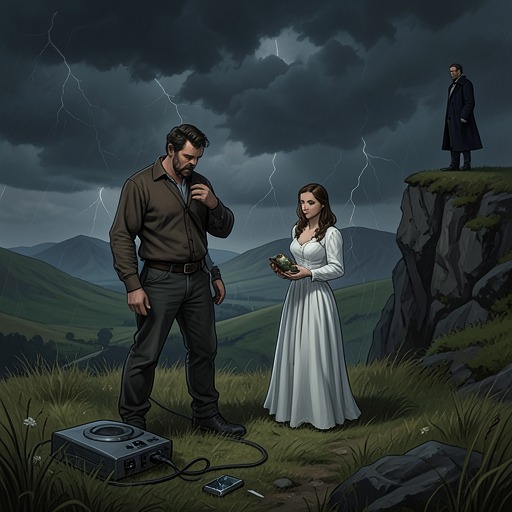
When Andrew again attributes the experience to concussion, Eric asks him to stop. Andrew refuses, saying that he loves Eric and will not let him surrender to an explanation he believes is false. Eric answers that he loves Andrew too, but insists that one of them must act. At the point when they are considering who will be sacrificed, Eric asks whether the light is present. It is not. He wishes it would appear and take him over as he imagines happened to the others, then lead him by the hand. Instead, he feels its absence; what remains is the woods, darkness, rain, thunder, and the two men.
Unresolved Meaning
The figure’s narrative function is defined by the gap between Eric’s certainty of experience and the lack of external confirmation. His first attempt to explain it away does not erase the force of what he felt; later, he speaks of the presence as real while still being unable to explain it. Andrew’s insistence on a medical explanation offers a grounded alternative, and Sabrina’s denial makes the possibility of supernatural meaning still more uncertain.
That uncertainty matters because Eric hopes the figure will relieve him of the final decision by taking control and guiding him. It does not. Andrew drops his gun and approaches Eric, and the two face the question of which of them will be chosen. The light supplies no command, sign, or rescue at that moment. The figure thus remains an unanswered possibility at the edge of the story’s central moral crisis: whether the presence was supernatural or a consequence of injury, Eric and Andrew must confront the choice without the guidance he longs for.